


Every child’s Hindi reading journey starts in the same place: learning to recognise the alphabet, one letter at a time. In Hindi, this first chart is commonly called the barakhadi or varnamala, and it’s the foundation everything else – words, matras, and full sentences – is built on. Here’s the complete chart with pictures, and a simple way to teach it at home.
What’s on a Hindi Barakhadi Chart
A Hindi barakhadi chart lays out every letter a child needs to start reading: the 13 vowels (स्वर), the consonants (व्यंजन), and a handful of conjunct letters formed by joining two consonants together. Once a child can recognise and name each of these on sight, they’re ready to move on to combining them into words.
The Complete Chart, With Pictures
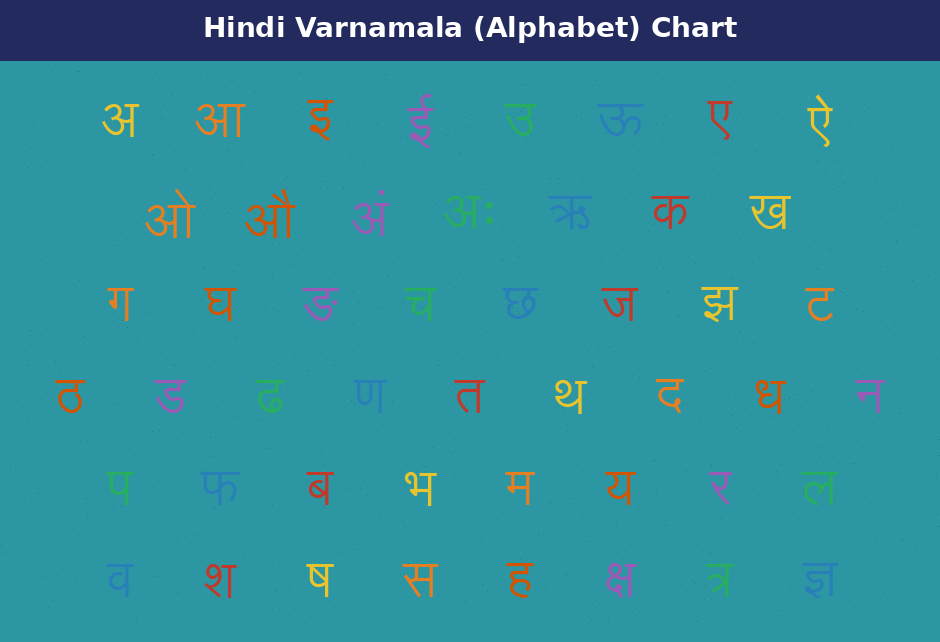
Vowels (स्वर) — 13 letters: अ आ इ ई उ ऊ ए ऐ ओ औ अं अः ऋ
Consonants (व्यंजन) — 32 letters: क ख ग घ ङ च छ ज झ ट ठ ड ढ ण त थ द ध न प फ ब भ म य र ल व श ष स ह
Conjunct letters (संयुक्ताक्षर) — 3 letters: क्ष त्र ज्ञ
That’s 48 letters in total — everything a child needs to start recognising and eventually reading Hindi script.
How to Teach the Alphabet at Home
- Start with the vowels. The 13 swar — अ, आ, इ, ई, उ, ऊ and the rest — are the building blocks for every consonant sound that follows, so they come first.
- Add 4–5 consonants at a time. Introducing all 32 consonants at once overwhelms most children. Small, repeated groups (क ख ग घ ङ, then च छ ज झ, and so on) stick better.
- Trace each letter shape. Tracing a raised, textured letter with a finger builds muscle memory that looking at a printed page alone doesn’t.
- Play, don’t test. Ten-minute point-and-say games or letter-matching hold a child’s attention far longer than repetition drills.
Once a child can confidently name every letter on this chart, they’re ready for the next stage of Hindi reading — learning how vowel signs (matras) change each consonant’s sound.
Why an EVA Foam Chart Works Better Than a Printed One
A printed alphabet chart is useful, but children under 6 learn best through touch as well as sight. The Kids Land Hindi Barakhadi mat turns the same 48 letters shown above into something a child can physically explore:
- Made from EVA (Ethylene Vinyl Acetate) foam, MultiColor, Density 75 (+/-10), Hardness Shore A 25–28
- BIS Certified for material safety
- Sized at 370 x 280 x 20 mm
- Designed for children from 4 years and above
- Part of Kids Land’s Educational product range
If your child is ready to move from looking at the alphabet to touching and pointing at it, the Hindi Barakhadi foam chart is available on the Kids Land website, alongside the Marathi Barakhadi mat and the rest of Kids Land’s educational foam toys.
Frequently Asked Questions
What letters are on a Hindi barakhadi chart?
A standard chart includes 13 vowels, the consonants, and a small set of conjunct letters formed from two consonants – together, everything needed to begin reading Hindi.
Is barakhadi the same as the Hindi alphabet?
“Barakhadi” is commonly used by parents to mean the Hindi alphabet chart used for early learning. It’s also sometimes used specifically for the vowel-sign (matra) system taught after the alphabet – the two are related but not identical.
At what age should a child start learning the Hindi alphabet?
Most children begin recognising individual letters from around age 3–4, which is why Kids Land’s foam charts are designed for children 4 years and up.
What comes after learning the alphabet?
Once a child recognises all the letters, the next step is learning matras – the vowel signs that combine with each consonant to form different sounds and, eventually, full words.
Where can I get a Hindi alphabet learning mat for my child?
Kids Land makes a BIS-certified EVA foam Hindi Barakhadi chart, available on the Kids Land website.
Related posts

Popular Posts
-
Diwali Gift Guide: Safe, Educational Toy Gifts for Kids This Festive Season
October 12, 2026 -
 The Benefits of Educational Foam Toys for Child Development
June 6, 2023 -
 Safe, Soft, and Super Fun: Kids Land’s Foam Toys for Hours of Playtime Joy!
July 5, 2023 -
Inspiring Young Minds with Educational Foam Toys from KidsLand
June 5, 2024 -
How Interactive Toys Enhance Learning in Early Childhood
July 1, 2024
Recent Comments