


For a child growing up in Maharashtra, the Marathi alphabet — commonly called the barakhadi or varnamala — is often the very first script they learn to recognise, well before they start writing full words. It’s the foundation for reading storybooks, school textbooks, and eventually every piece of written Marathi they’ll encounter. This guide walks through the complete chart, why early alphabet recognition matters, and how to actually teach it at home without turning it into a chore.
Why Early Alphabet Recognition Matters
Before a child can read a single word, they need to recognise each letter on sight and connect it to a sound — a skill educators call phonemic awareness. This isn’t a small milestone. Research on early literacy consistently shows that children who can confidently name letters before age 5 tend to pick up reading faster once formal schooling begins, because they’re not learning two things at once (letter shapes and reading) — just one.
For Marathi specifically, this groundwork also builds a child’s connection to their mother tongue and regional culture, long before English or Hindi enter the picture through school.
What Is Barakhadi? Understanding Swar, Vyanjan & Jodakshare
A Marathi barakhadi chart is organised into three distinct groups, and understanding the difference helps parents teach it in the right order:
- स्वर (Swar / Vowels) — the base sounds, like अ, आ, इ, ई. These are typically taught first because every consonant is eventually combined with them.
- व्यंजन (Vyanjan / Consonants) — the bulk of the alphabet, from क to ह, each representing a distinct consonant sound on its own.
- जोडाक्षरे (Jodakshare / Conjunct letters) — special letters formed by joining two consonant sounds together, such as क्ष and ज्ञ. These are usually introduced last, once a child is confident with the rest.
The Complete Marathi Varnamala Chart
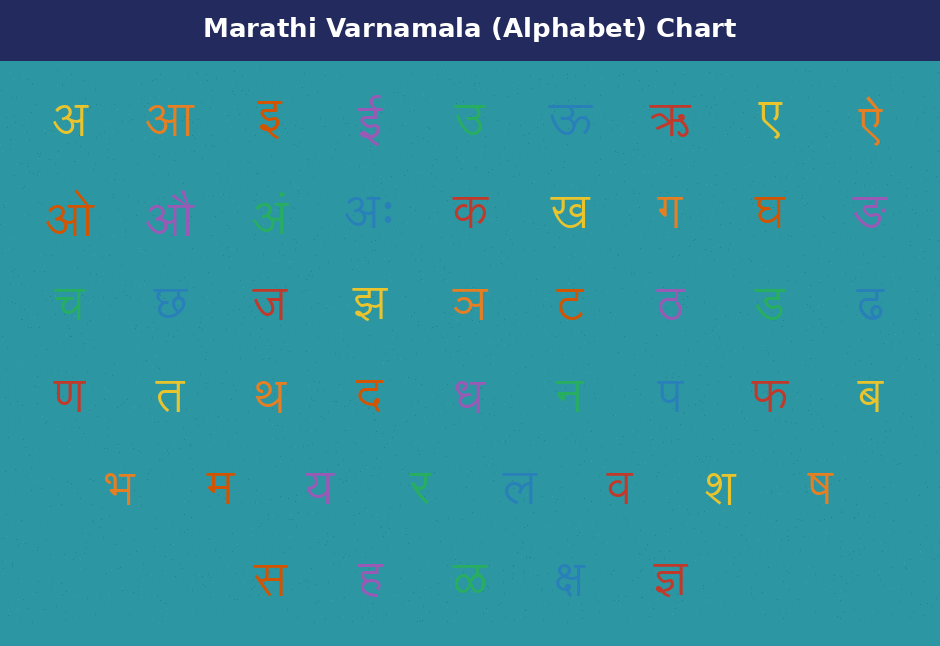
Vowels (स्वर): अ आ इ ई उ ऊ ऋ ए ऐ ओ औ अं अः
Consonants (व्यंजन): क ख ग घ ङ च छ ज झ ञ ट ठ ड ढ ण त थ द ध न प फ ब भ म य र ल व श ष स ह ळ
Conjunct letters (जोडाक्षरे): क्ष ज्ञ
The Letter ळ: Marathi’s Own Sound
One letter deserves special mention: ळ (a retroflex “la” sound, articulated with the tongue curled further back than a regular ल). It appears in everyday Marathi words a child will recognise quickly once they know the sound — फळ (fruit), आवळा (gooseberry), खळखळाट (a gurgling sound). Because it’s a sound with no close substitute, it often needs a little extra repetition compared to the rest of the chart — most children get it with consistent, playful practice over a couple of weeks.
How to Teach the Marathi Alphabet at Home
- Start with the vowels. The swar — अ, आ, इ, ई, उ, ऊ and the rest — form the base sounds every consonant builds on, so they come first.
- Add 4–5 consonants at a time. Introducing all 36 consonants in one sitting overwhelms most children. Small groups, repeated daily, stick far better.
- Give ळ its own practice time. Use it in real, familiar words rather than in isolation — “फळ,” said aloud together, works better than the letter on its own.
- Play, don’t test. Ten-minute point-and-say or matching games hold a child’s attention far longer than repetition drills or quizzes.
Common Mistakes Parents Make When Teaching Barakhadi
- Rushing to matras (vowel signs) before the alphabet is solid. A child who can’t yet recognise consonants confidently will struggle even more once vowel signs are added. Alphabet mastery should come first.
- Testing instead of playing. Quizzing a young child (“What’s this letter?”) on repeat creates pressure and can make them associate learning with anxiety. Games achieve the same recall with none of the stress.
- Skipping touch and movement. Children under 6 learn faster when a lesson involves more than just looking — tracing, pointing, and physically moving pieces around all reinforce memory in ways flashcards alone don’t.
- Going in strict alphabetical order. There’s no rule that says क must come before ल. Starting with letters from your child’s own name or favourite words often builds motivation faster.
- One long session instead of many short ones. A single 30-minute sitting is far less effective than five separate 5–10 minute sessions spread across the day.
Fun Practice Games
- Letter Hunt — call out a letter and have your child find and touch it on the chart as fast as they can.
- I Spy — “I spy something starting with… म” — point to objects around the house that match.
- Sound Train — say a chain of sounds and have your child name the next letter that “belongs” in the sequence.
- Matching Pairs — write a few letters on small paper cards and have your child match each one to the same letter on the foam chart.
- Rhyme & Repeat — many Marathi preschools teach the barakhadi through simple sing-song rhymes; repeating letters in a rhythm helps recall stick faster than silent reading.
Why an EVA Foam Chart Works Better Than a Printed One
The Kids Land Marathi Barakhadi mat turns the alphabet into something a child can touch as well as see — which matters, given how much early letter recognition depends on more than just looking:
- Made from EVA (Ethylene Vinyl Acetate) foam, MultiColor, Density 75 (+/-10), Hardness Shore A 25–28
- BIS Certified for material safety
- Sized at 370 x 280 x 20 mm
- Designed for children from 4 years and above
- Part of Kids Land’s Educational product range
You can find the Marathi Barakhadi foam chart on the Kids Land website, alongside the rest of Kids Land’s educational foam toys.
Frequently Asked Questions
What letters are on a Marathi barakhadi chart?
It includes the vowels (स्वर), the consonants (व्यंजन), and a small set of conjunct letters (जोडाक्षरे) — including ळ, a sound unique to Marathi.
What is the difference between स्वर and व्यंजन?
Swar (vowels) are standalone sounds like अ and आ. Vyanjan (consonants) are sounds like क and ख that combine with vowels to form syllables and words.
At what age should a child start learning the Marathi alphabet?
Most children begin recognising individual letters from around age 3–4, which is why foam learning charts like this one are designed for children 4 years and up.
How long does it typically take to learn the full alphabet?
With short daily practice, most children recognise the full set of vowels and common consonants within 6–8 weeks. Less frequently used consonants and conjunct letters usually take longer and are best introduced gradually.
Are foam learning mats safe for young children?
Kids Land’s Marathi Barakhadi mat is made from BIS-certified EVA foam, a soft, non-toxic material designed for children 4 years and above.
Where can I get a Marathi alphabet learning mat for my child?
Kids Land makes a BIS-certified EVA foam Marathi Barakhadi chart, available on the Kids Land website.
Related posts

Popular Posts
-
Learn ABCD and Numbers 1 to 10: A Fun Guide for Kids
September 13, 2026 -
 The Benefits of Educational Foam Toys for Child Development
June 6, 2023 -
 Safe, Soft, and Super Fun: Kids Land’s Foam Toys for Hours of Playtime Joy!
July 5, 2023 -
Inspiring Young Minds with Educational Foam Toys from KidsLand
June 5, 2024 -
How Interactive Toys Enhance Learning in Early Childhood
July 1, 2024
Recent Comments