


Almost every child goes through a phase of being fascinated by vehicles. They point out buses from the window, shout when a train passes, and line up toy cars across the floor. It is more than a passing interest. Transport is one of the first topics children meet in early school, and it gives parents an easy way to build vocabulary, counting, sorting and curiosity about how the world works. This guide explains the main means of transport in plain language, offers games you can play at home, covers basic road safety, and shows how puzzles fit in.
What Is Transport?
Transport means moving people or goods from one place to another. When a family travels to a grandparent’s home, when vegetables arrive at the market, or when a child goes to school, some form of transport is involved. Explaining it this way helps young children see that vehicles are not just toys, they are part of everyday life.
Why Vehicles Make Such Good Learning Material
Vehicles are a rare subject that children choose for themselves, which is half the work of teaching already done. They support several skills at once:
- Vocabulary. Words like wheel, engine, track, passenger and station come up naturally.
- Counting. How many wheels does a car have? How many carriages are in the train?
- Sorting. Does it travel on land, water or air? Does it carry people or goods?
- Curiosity. Children begin asking how things work, which is where early science starts.
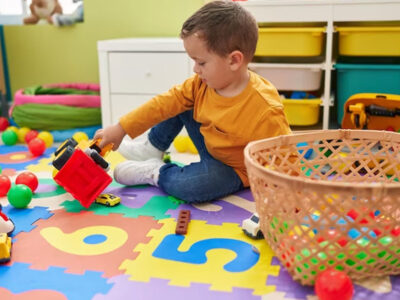
Hands-on play adds to this. A child who has built a vehicle from pieces understands its parts in a way that a picture cannot show, and puzzle play builds thinking skills such as planning, matching and problem solving alongside the vocabulary.
Types of Transport: Land, Water and Air
Means of transport are usually grouped by where they travel. Sorting them this way is also a useful first lesson in classification.
Land transport moves on roads or tracks:
- Bicycle, scooter and motorcycle
- Car, auto-rickshaw, taxi and bus
- Train, metro and tram
- Bullock cart and tempo
Water transport moves on rivers, lakes and seas:
- Boat and canoe
- Ferry
- Ship
Air transport moves through the sky:
- Aeroplane
- Helicopter
- Hot air balloon
India offers plenty of local examples for children to relate to: the auto-rickshaw outside the house, the local train in a big city, the ferry on a river crossing, or the bullock cart on a village road. Starting with what a child has actually seen makes the lesson stick far better than a picture from a book.
Learning with the Car Puzzle
The car is the vehicle children know best, because they ride in one or see one every day. That familiarity makes it a good starting point. Kids Land’s Car Puzzle is made from BIS-certified EVA foam in multiple colours, in the same educational range as the rest of the brand’s puzzles, designed for children aged 4 and above.
While your child works on it, talk about what they are doing: “Where does this piece go?”, “What colour is this part?”, “What does a car need to move?” These small questions turn a few minutes of puzzle time into a conversation, and they help a child connect the foam shapes in front of them to the real cars outside.
All Aboard: Learning with the Train Puzzle
Trains are close to the heart of Indian childhood, whether it is the long-distance journey to a relative’s town or the sight of a passing train from a railway crossing. A train is also a good teaching object because it is made of a sequence: engine first, then carriages, one after another.
The Train Puzzle from Kids Land gives children a hands-on way to explore that idea, in the same soft, durable EVA foam as the rest of the range. Ask your child questions that build sequencing: “Which part goes first?”, “How many carriages can you count?”, “Who might be sitting inside?” Making up a short story about where the train is going adds language practice without feeling like a lesson.
Trains Run on Time: Introducing the Clock
Trains and buses run to timetables, which gives you a natural way to introduce the idea of time. “The train leaves at eight” means little to a young child until they can see the hands of a clock, and a vehicle game is a low-pressure way to start. If your child is ready to learn, our guide on how to teach kids to tell time explains the parts of a clock and a simple order to teach them in, starting with the hour hand.
Simple Transport Games to Play at Home
You do not need any equipment for these:
- Vehicle spotting. On a walk or a drive, ask your child to spot a car, a bus or an auto-rickshaw and count how many they find.
- Land, water or air. Name a vehicle and have your child tell you where it travels, or sort pictures and toys into three piles.
- Count the wheels. Choose a vehicle and count its wheels together. A bicycle has two, a car has four, a bus has more. It is easy practice with numbers in a way children enjoy.
- Sound game. Make the sound of a horn, a train or a bell and let your child guess the vehicle.
- Play station. Turn the living room into a railway station or a bus stop, with tickets made from scrap paper and passengers played by soft toys.
Road Safety Basics for Young Children
Talking about vehicles is a good moment to introduce basic safety, and the earlier it becomes habit, the better. A few simple rules for young children:
- Hold an adult’s hand near roads and while crossing.
- Cross at zebra crossings and only when an adult says it is safe.
- Stop, look right and left, and listen before crossing.
- Always wear a seat belt in a car, and a helmet on a two-wheeler.
- Remember the traffic light colours: red means stop, yellow means get ready, and green means go.
Turning these into a game, for example “red light, green light” in the living room, helps children remember them. Because children handle foam toys so often, the material matters too, and parents may want to read about whether EVA foam is safe for children before choosing any puzzle for the floor.
Choosing the Right Puzzle
A good learning puzzle has a clear theme the child already cares about, pieces that are easy to hold, and a safe, tested material. Vehicle puzzles score well on all three. Check the age range on any toy you buy, and match it to your child’s current stage rather than the one you hope they reach. You can browse the full range in the Kids Land shop.
Frequently Asked Questions
What are the three main types of transport?
Land transport (such as cars, buses and trains), water transport (such as boats and ships) and air transport (such as aeroplanes and helicopters).
How do I teach my child about means of transport?
Start with vehicles your child already sees, such as a car, bus or auto-rickshaw, and then add trains, boats and aeroplanes. Games like vehicle spotting and sorting by land, water and air make it enjoyable.
What age is suitable for car and train puzzles?
Kids Land’s educational foam puzzles are designed for children aged 4 years and above.
Are foam puzzles safe for young children?
Kids Land’s puzzles are made from BIS-certified EVA foam. Always check the recommended age on any toy before buying.
Can schools and playgroups order puzzles in bulk?
Kids Land offers bulk ordering for schools, playgroups, anganwadi centres and retailers.
Related posts

Popular Posts
-
Means of Transport for Kids: A Simple Guide to Learning with Car and Train Puzzles
October 22, 2026 -
 The Benefits of Educational Foam Toys for Child Development
June 6, 2023 -
 Safe, Soft, and Super Fun: Kids Land’s Foam Toys for Hours of Playtime Joy!
July 5, 2023 -
Inspiring Young Minds with Educational Foam Toys from KidsLand
June 5, 2024 -
How Interactive Toys Enhance Learning in Early Childhood
July 1, 2024
Recent Comments